

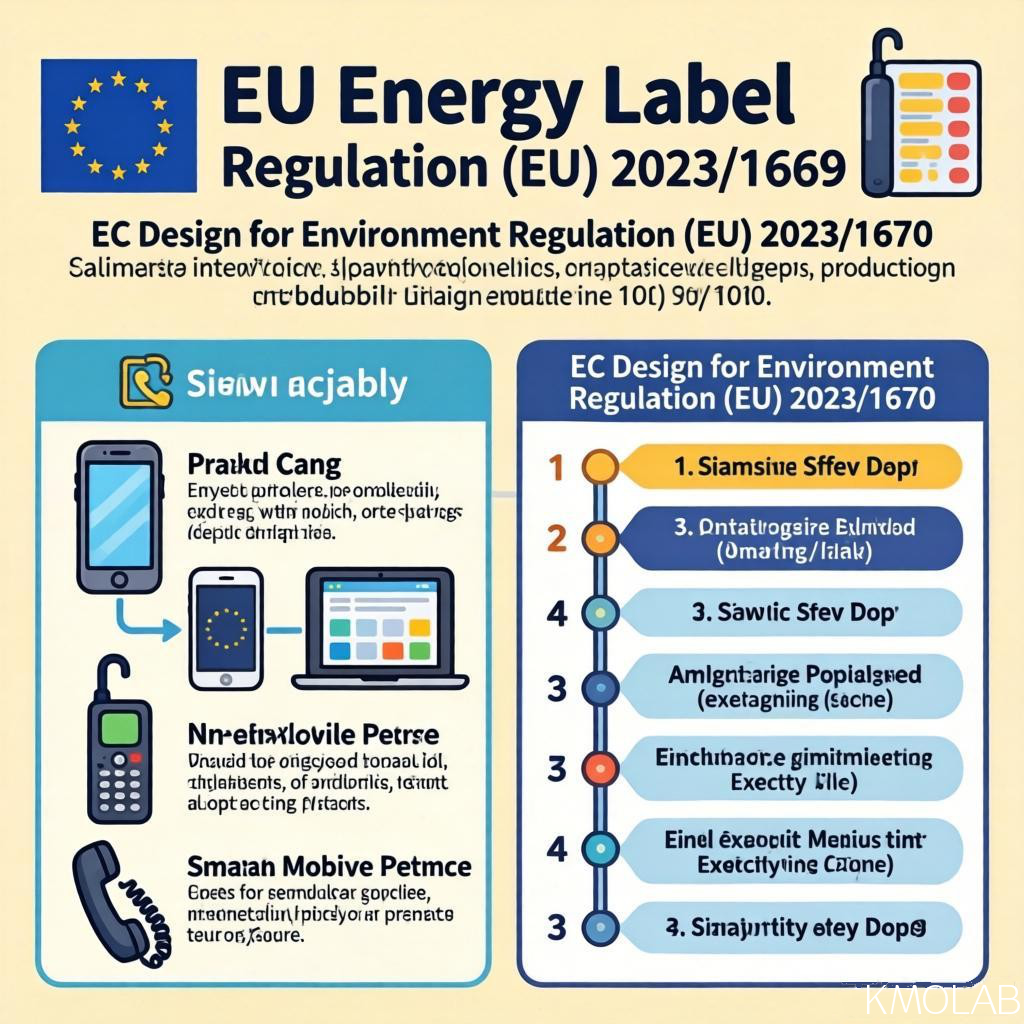
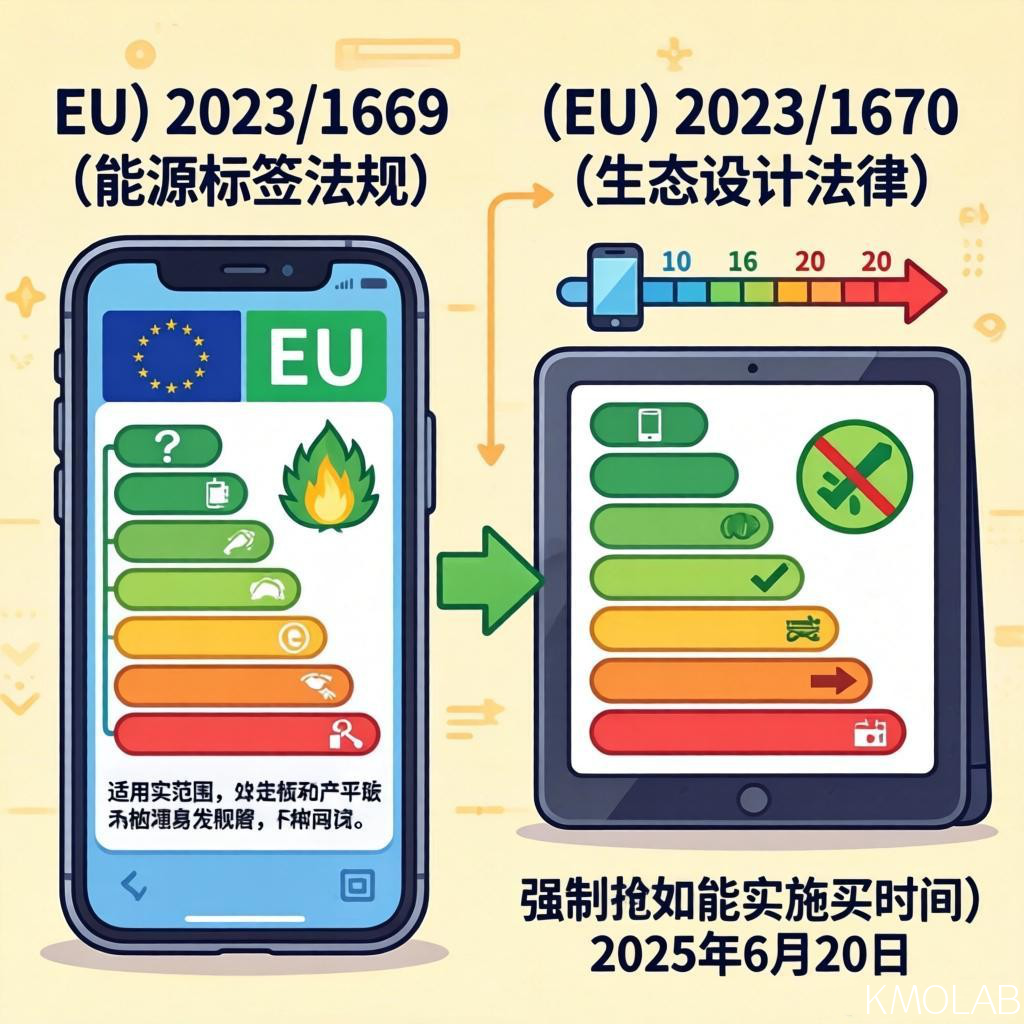
(Shenzhen, China) – As of 20 June 2025, the EU Energy Labelling Regulation ((EU) 2023/1669) and Ecodesign Regulation ((EU) 2023/1670) for smartphones and tablets have become fully mandatory. All smartphones, tablets and cordless phones placed on the EU market must now undergo energy efficiency testing, register in the EPREL database, display an energy label, and meet ecodesign requirements covering repairability, spare parts availability, software updates and battery durability. Non-compliant products are prohibited from sale in the EU.
KE MEI OU LAB CO., LTD. (“Ke Mei Ou Lab”), one of China‘s leading third-party testing and certification bodies, has formally added the following two regulations to its ISO/IEC 17025:2017 accreditation scope (ANAB Certificate No. AT-1532), becoming one of the few accredited laboratories in China with full testing capabilities for these requirements:
(EU) 2023/1669 – Energy labelling of smartphones and slate tablets
(EU) 2023/1670 – Ecodesign requirements for smartphones, mobile phones other than smartphones, cordless phones and slate tablets
Ke Mei Ou Lab now offers one-stop compliance testing and EPREL registration support for smart device manufacturers exporting to the EU, helping Chinese-made products navigate newly established energy efficiency and environmental requirements and efficiently enter the European market.
On 31 August 2023, the European Commission published the Ecodesign Regulation (EU) 2023/1670 and the Energy Labelling Regulation (EU) 2023/1669, developed under the EU‘s *Ecodesign and Energy Labelling Working Plan 2022-2024*. These regulations became fully mandatory on 20 June 2025 [12†L6-L8].
According to EU projections, smartphones and tablets produced under the Ecodesign Regulation will save nearly 14 TWh of primary energy per year by 2030 – equivalent to one-third of current primary energy consumption of these products .
Scope of application:
Smartphones, cordless phones, feature phones
Slate tablets with screen sizes between 7 and 17.4 inches
Exemptions: Rollable/foldable screen devices, high-security communication terminals (e.g., government/defense encrypted devices), and products already placed on the market before 20 June 2025 (as stock‑in‑trade for transitional sales)
Regulatory authority: Both regulations were established under the framework of the Ecodesign Directive (2009/125/EC) and also adopt principles from the Ecodesign for Sustainable Products Regulation (ESPR), governing product durability, repairability and recycled content to reduce environmental impact across the full product lifecycle .
All smartphones and tablets placed on the EU market must display an A–G energy efficiency label on product packaging and complete registration in the EPREL database before sale The energy label includes the following information:
| Item | Information | Description |
|---|---|---|
| 1 | QR code | Scannable link to full product energy information |
| 2 | Brand and model | Product identification information |
| 3 | A–G energy class | A (most efficient) to G (least efficient) |
| 4 | Battery endurance | Usage time per full charge |
| 5 | Drop resistance rating (A to E) | Based on repeated free-fall testing |
| 6 | Battery cycle life | Number of full charge/discharge cycles |
| 7 | Repairability rating (A to E) | A (easiest to repair) to E (hardest) |
| 8 | IP rating | Dust and water ingress protection |
| 9 | Regulation reference | Regulatory identification number |
EPREL database registration requires identity verification using a Qualified e-Seal compliant with the eIDAS regulation. Manufacturers must upload test reports, technical documentation and declarations of conformity to EPREL before the official energy label can be generated .
The Ecodesign Regulation establishes mandatory minimum standards for smartphones, cordless phones and tablets placed on the EU market across multiple dimensions – repairability, battery durability, software updates and robustness:
| Ecodesign Requirement | Specific Provisions |
|---|---|
| Repairability | Manufacturers must supply key spare parts (batteries, screens, charging ports) to repairers within 5-10 working days and continue supply for at least 7 years after the last product is placed on the market |
| Battery durability | Smartphones and tablets: 800 full charge/discharge cycles while retaining at least 80% of initial capacity; other mobile phones: 500 cycles |
| Software updates | Operating system security and functional updates must be provided for at least 5 years after the last unit of the product model is placed on the market |
| Robustness | Devices must withstand 45 drops from 1 metre without failure, have screen hardness of at least Mohs hardness grade 4, and display IP dust/water protection rating |
| Materials & recycling | Plastic parts >50g must indicate polymer type; critical raw material usage (cobalt, tantalum, etc.) must be disclosed on the manufacturer‘s website; end-of-life recycling must comply with the WEEE Directive |
| Repair information access | Professional repairers must have non‑discriminatory access to required software/firmware for repairs; manufacturers must publish repair manuals (including disassembly diagrams) on a free-access website |
Conformity assessment: Conformity with ecodesign requirements must be demonstrated through internal design control or management system audit in accordance with Article 8 of the Ecodesign Directive 2009/125/EC and the conformity assessment procedures set out in Annex V [11†L10-L11]. Ke Mei Ou Lab‘s third-party test reports and assessment documentation serve as the essential technical basis for manufacturers‘ internal production control self-declarations of conformity.
Ke Mei Ou Lab has already implemented the core testing standards under the EU ErP energy efficiency framework, providing a solid technical foundation for compliance with (EU) 2023/1669 and (EU) 2023/1670:
| Standard | Scope |
|---|---|
| EN 50564:2011 | Measurement of standby/off‑mode power consumption of electrical and electronic products (equivalent to IEC 62301:2011); written to support EC Regulation 1275/2008 for off‑mode and standby mode power measurement |
| EN/IEC 62087-7 | Methods of measurement for power consumption of audio, video and related equipment |
| EN 50643 | Measurement of networked standby power consumption of edge equipment; written to support Commission Regulation (EU) No 801/2013 for networked standby energy measurement |
Ke Mei Ou Lab offers full compliance testing for smartphones, tablets and cordless phones:
| Test Item | Applicable Regulation | Test Content |
|---|---|---|
| Energy efficiency rating | (EU) 2023/1669 | Determine A–G energy class per EN 50564 etc. |
| Battery durability | (EU) 2023/1670 | Verify ≥80% capacity retention after 800 cycles |
| Drop resistance | (EU) 2023/1669/1670 | 45 drops from 1 metre; drop rating classification |
| IP rating | (EU) 2023/1669 | Verify dust/water ingress protection level |
| Repairability assessment | (EU) 2023/1670 | uate disassembly ease and spare part replaceability |
| Software update support | (EU) 2023/1670 | Assess OS and security update capability |
| Material & recycling marking | (EU) 2023/1670 | Plastic part identification & critical raw material disclosure |
| Power measurement | EN 50564 / EN 50643 | Standby/off‑mode/networked standby power measurement |
Ke Mei Ou Lab provides comprehensive EPREL registration support:
Issuance of energy efficiency test reports (prerequisite for registration)
Preparation and review of product technical documentation
Drafting of Declaration of Conformity (DoC)
Guidance on EPREL database registration (including e-Seal application)
Ke Mei Ou Lab is one of the few testing laboratories in China accredited to perform full‑scope testing to (EU) 2023/1669 and (EU) 2023/1670. This capability delivers significant value to Chinese smart device manufacturers:
Meet mandatory regulations: Both regulations became fully enforceable on 20 June 2025. Ke Mei Ou Lab helps clients complete compliance testing, issue test reports, and support EPREL registration before market entry, avoiding customs risks and market bans.
One‑stop registration prerequisites: From energy efficiency testing and battery durability verification to drop testing and repairability assessment, all tests can be completed in a single laboratory, eliminating coordination costs across multiple labs.
Multi‑regulation simultaneous coverage: The laboratory offers EMC, RF, safety, energy efficiency, acoustics and cybersecurity testing capabilities, complemented by EN 18031 series (EU RED mandatory cybersecurity standards) and ETSI EN 303 645 (IoT cybersecurity) – enabling comprehensive global market access certification for smartphones and tablets.
Deep regulatory expertise: Ke Mei Ou Lab‘s technical team has conducted systematic research on both regulations and can provide end‑to‑end technical consulting – from product design rectification to test plan optimization.
| Product Category | Applicable Regulation | Test Content |
|---|---|---|
| Smartphones | (EU) 2023/1669 + 1670 | Energy label, battery durability (800 cycles), drop resistance, IP rating, repairability, software updates |
| Tablets (7-17.4 inches) | (EU) 2023/1669 + 1670 | Energy label, battery durability (800 cycles), drop resistance, IP rating, repairability, software updates |
| Cordless phones | (EU) 2023/1670 | Ecodesign requirements (repairability, spare parts supply, battery durability) |
| Feature phones | (EU) 2023/1670 | Battery durability (500 cycles), repairability, etc. |
Exemptions (not subject to these two regulations, but may be subject to other requirements – please contact Ke Mei Ou Lab for case‑by‑case compliance consultation):
Rollable/foldable screen devices
High-security communication terminals
Products already placed on the market before 20 June 2025 (as stock‑in‑trade for transitional sales)
For specific details and requirements, please contact our KMO! ->> kmo@kmolab.com
 Follow us for the latest news
 Working hours: 9:00-18:30, Monday to Friday
Contact:Lisa Liu
Mobile:18028790769
Email: kmo@kmolab.com
Address:Room 2013, 20th Floor, Business Center, Jiahui Xin Cheng, No 3027, Shen Nan Road, Fu Tian, Shen Zhen, Guang Dong, China